
Bonn Ethics Lab
Exploring, shaping, and making interdisciplinary ethics visible.
The Bonn Ethics Lab provides an interdisciplinary platform for students to investigate ethical questions and create digital formats such as podcasts and videos.
About the Lab
The Bonn Ethics Lab is an interdisciplinary project for students from various fields who wish to engage with ethical questions. It provides a space for exchange, collaborative learning, and the creative development of ideas—regardless of academic experience level.
A key component of the program is the introduction to fundamental ethical theories. These theoretical foundations enable participants to analyze and discuss ethical dilemmas from the perspectives of their respective disciplines.
In addition to reflecting on ethical issues, the Bonn Ethics Lab places great emphasis on science communication. Findings are prepared in digital formats such as videos or podcasts and made accessible to the public. In this way, the Bonn Ethics Lab serves as an interface between science and society, contributing to the integration of ethical topics into a broader discourse.
The Bonn Ethics Lab is based on the principles of research-based learning and peer learning, combined with individualized coaching. Research-based learning involves self-organized and self-directed learning, where participants independently engage with a specific question. This process is open-ended and fosters exploratory learning, with instructors taking on a supportive and moderating role. As a result, critical thinking, problem-solving skills, and intrinsic motivation for acquiring knowledge are strengthened. Peer learning emphasizes learning from and with each other, regardless of academic status. Knowledge and experiences are exchanged in a collaborative environment to deepen understanding and enhance communication skills. Individualized coaching accompanies the entire learning and experience process, allowing for personal needs to be addressed while fostering individual strengths and competencies.
The Basic Module of the Bonn Ethics Lab is designed for students in the early semesters of a degree program (Bachelor’s level or equivalent) who have gained initial experience in academic work and wish to deepen their skills in the lab. The primary focus of this module is the development of an ethical research outcome.
The Advanced Module is open to Master’s students as well as advanced Bachelor’s and degree program students who have either completed the Basic Module or bring their own research topic or previously written academic papers. This module emphasizes science communication, enabling participants to effectively present and share ethical insights with a broader audience.
Course Structure
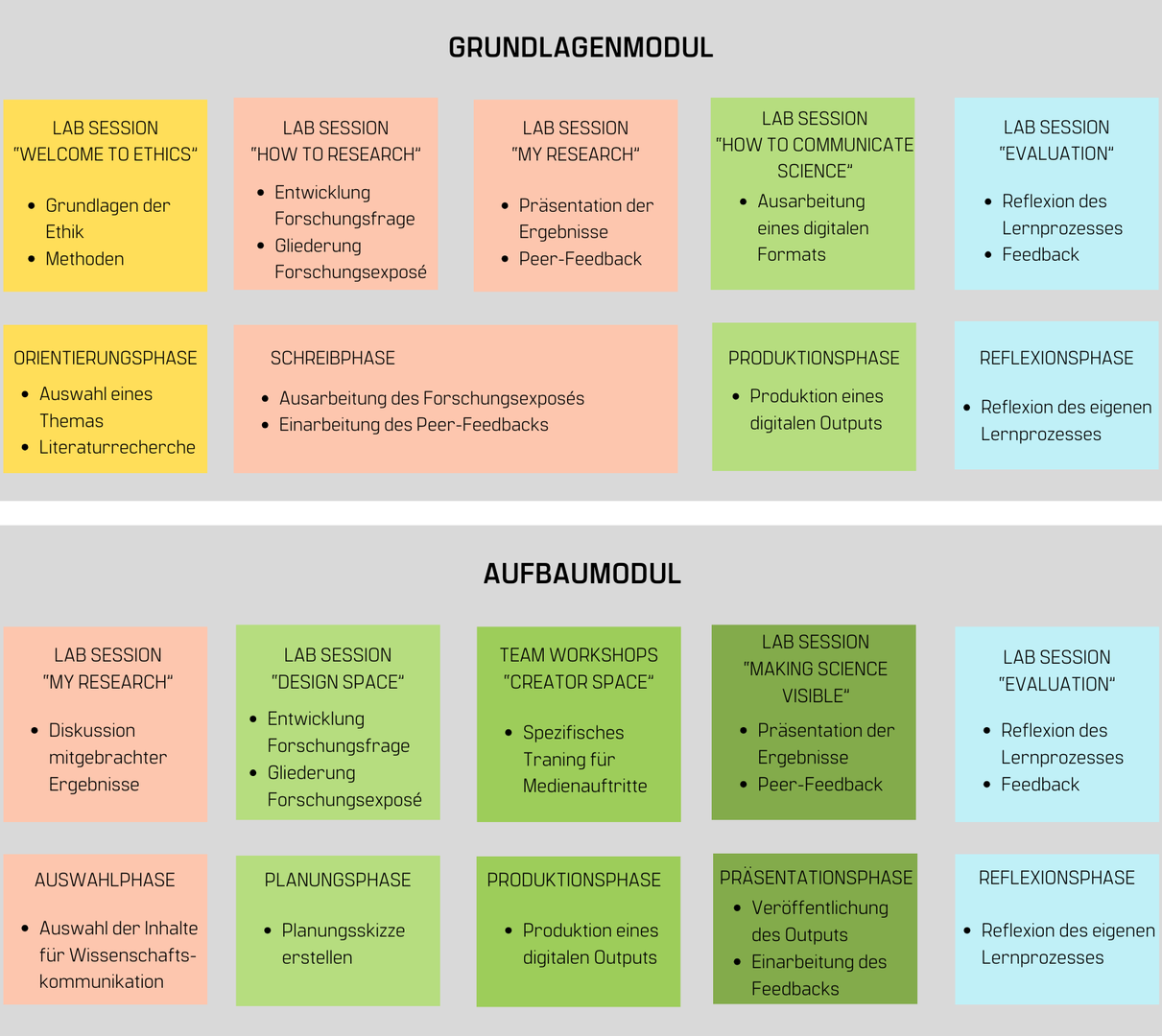
The Bonn Ethics Lab consists of a Basic Module and an Advanced Module, each awarding 6 ECTS credits. The modules can be taken either sequentially or independently, making them suitable for different academic paths.
Both modules are divided into lab phases, in which students learn and work together as a group, and independent study phases, during which they receive individual support and guidance.
01.
Podcast
In podcasts, research findings can be discussed, and interviews with experts can be conducted. Podcasts are ideal for providing deeper insights into academic work, facilitating discussions, and fostering inspiring science communication.
02.
Video
Whether short reels or more in-depth videos, video formats are an effective way to visually present key findings. Through interviews, animations, or explainer videos, topics can be conveyed in an engaging and dynamic manner.
03.
Other
Whether interactive web documentaries, digital exhibitions, Instagram posts, science slam or blog articles – students have the freedom to choose a format that best conveys their topic. We look forward to innovative and creative approaches!
Registration
You can now register for the Bonn Ethics Lab on BASIS:
Please make sure to register for the coaching session as well.
Note: For law students, please send a registration request to "ethlab@uni-bonn.de"
The posts/videos below were created by professors and students from "Bonn Ethics Lab".

Cheap and Fair
When paragraphs collide with principles and morality clashes with legal texts, things get interesting. In this podcast, two perspectives come together: Susanne Gössl, Professor of Law at the University of Bonn, and Matthias Braun, Professor of Ethics at the University of Bonn, discuss current social issues at the intersection of law and ethics. From legal and ethical perspectives, they shed light on current debates, challenge existing norms and highlight where conflicts arise. With in-depth expertise, wit and an open-minded approach to different arguments, the hosts invite you to think along, weigh up the options and critically examine your own views. Enjoy listening!

Protestant Church Day
Today on the Bonn Ethics Lab channel, there's a guest post from another seminar at our chair: Courageous - Strong - Resolute. In this seminar, students attended the German Protestant Church Assembly, developed an ethical research project, and created a video or podcast from their findings!
How can the church better support queer people? To find answers to this question, I attended several queer events at the Church Assembly in Hanover.

Brain-Computer Interfaces in Cyberpunk - What's the ethical perspective?
This video uses the dystopian world of cyberpunk as an example to explore the ethical and social implications of sophisticated brain-computer interfaces: What happens when military institutions use neurotechnological implants to transform people into living weapons, undermining their autonomy and leaving freedom as an illusion?
Our team is interdisciplinary, bringing together expertise from the Faculty of Protestant Theology, Law, and Computer Science.
For general inquiries, please contact us at "ethlab_at_uni-bonn.de".
If your message is intended for a specific team member, kindly include their email address in CC to ensure proper delivery and follow-up.

Lorenz Garbe





Julius Reiling
