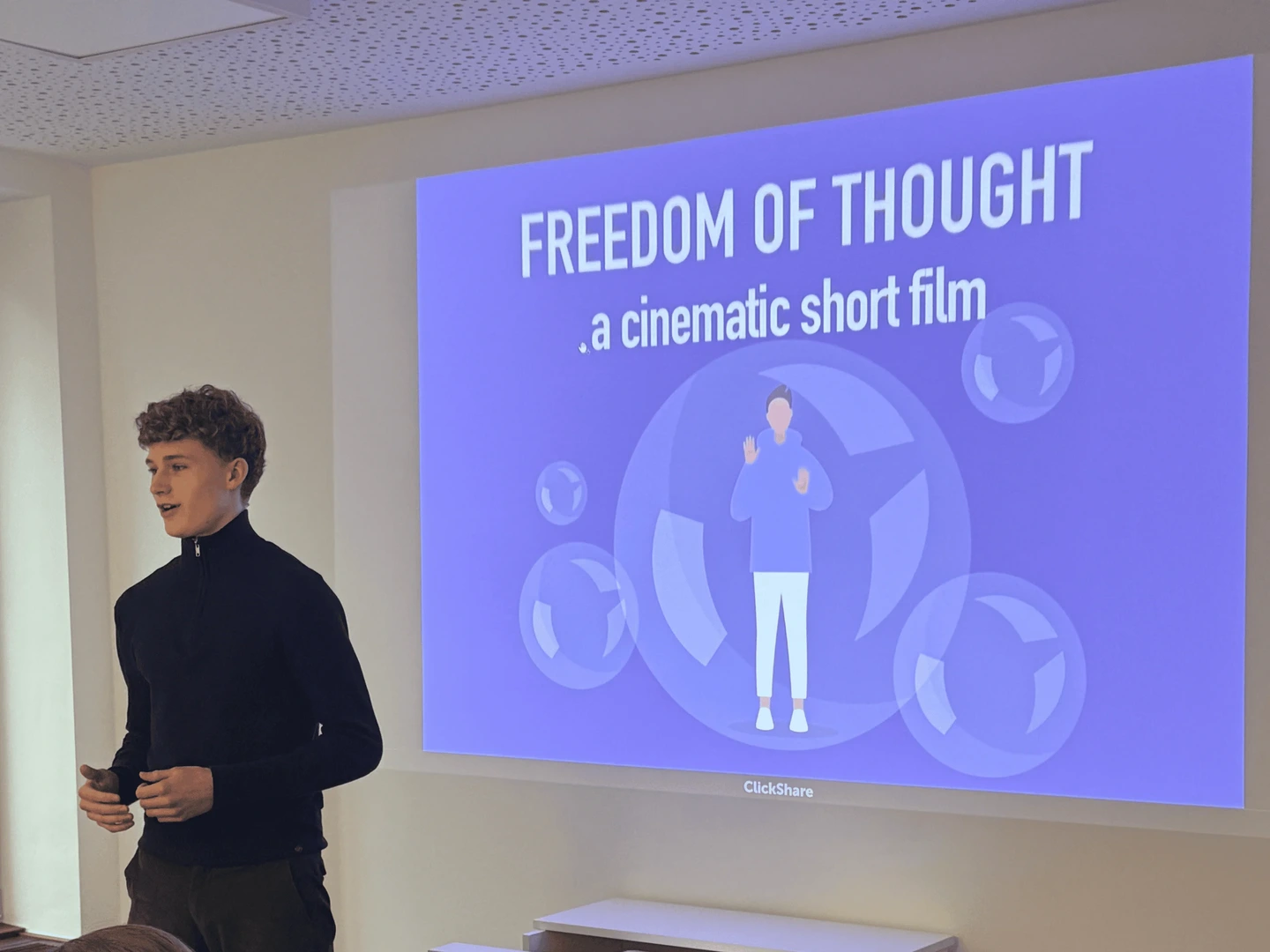
Human rights standards are coming under pressure, especially in times of increasing social tensions, growing social inequality, and global challenges such as climate change. The students' visit therefore provided a valuable opportunity to learn about young people's perspectives and to engage with them in a discussion about the relevance, vulnerability, and sustainability of human rights.
Pitch: Creative approaches to freedom of expression
After the students arrived in Bonn, the day began with the presentation of the competition entries to be submitted to the European Student Competition early next year. The 11th graders chose their project focus in advance and developed project ideas on freedom of expression in a variety of media formats – texts, drawings, podcasts, videos, and even self-programmed games – under the heading “Thoughts are free...or are they?”
The students presented their concepts in 60-second pitches, followed by a four-minute question and answer session and structured feedback from the chair team (Matthias Braun, Anna Lene Strauß, and Carla Spielmann). The students creatively demonstrated how thoughts can be manipulated and how we can protect ourselves from negative influences. The contributions ranged from general reflections on freedom of expression to experiences with discrimination and dealing with misinformation on social networks.
City tour: Human rights in Bonn
This was followed by a themed tour of Bonn city center and the university campus. As the former seat of government and location of key democratic institutions, the city provided a vivid backdrop for discussing historical developments and current challenges relating to fundamental and human rights. The students explored historical landmarks such as Bonn City Hall, the Schlosskirche church, and the Hofgarten park, as well as current political tensions that affect the protection of freedoms and rights of participation.
In the arcaded courtyard of the university's main building, the students discussed the significance and limits of academic freedom as an expression of Article 5 of the German Constitution, using the pandemic as an example. In their contributions, they noted that science must fulfill the function of satisfying the knowledge needs of the state and society. After all, according to the students, the state itself does not have a knowledge advantage that could legitimize its rule. Rather, it often has to obtain the information necessary for decision-making first.
On the other hand, the students saw the limits of academic freedom as being reached when the fundamental rights of third parties or other constitutional rights are threatened, or when scientists reproduce misanthropic, anti-democratic, and nationalistic attitudes in their work.
Participation in the democracy project
After a joint lunch break in the cafeteria, the young people took the opportunity to give feedback on a project run by the Chair on the topic of democracy education in German schools. The discussion and the students' participation highlighted how relevant the topics of democracy and participation are from the perspective of young people and how important it is, for this very reason, to open up spaces for reflection, criticism, and creativity at an early stage.
Outlook
The visit ended at around 2 p.m. with the departure of the students. What remained was the impression of an extremely engaging exchange that made it clear that human rights education is particularly effective when it opens up spaces for experience, takes different perspectives seriously, and works dialogically. The Chair of Social Ethics will continue to promote formats in which academic expertise and young voices work together to highlight the importance of human rights for German society and Europe.