Where can you listen to us?
New episodes of our podcast “billig und gerecht” are released every first Thursday of the month, either here on our website or wherever you listen to podcasts.
A quick note: This podcast is in German. If you feel comfortable with the language, we’d be thrilled if you gave it a listen!
The new podcast "billig und gerecht"
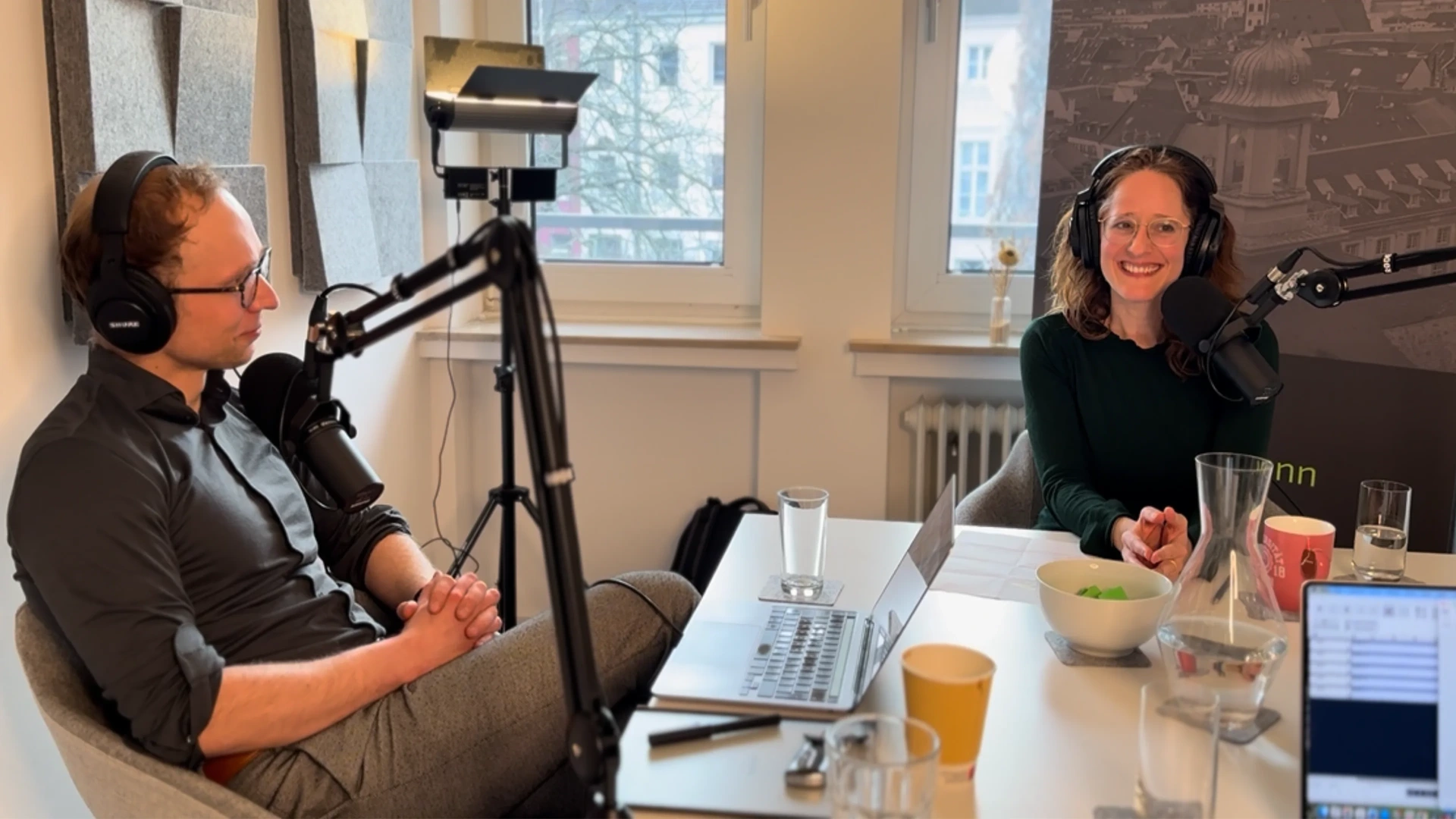
Once a month, Matthias Braun (Chair of Social Ethics) and Susanne Gössl (Chair of German, Foreign, and International Private Law and the Law of Digitalization) examine highly contentious social debates from their respective ethical and legal perspectives and attempt to bring some clarity to the arguments behind them. The challenge here: sometimes having to argue for a position that you yourself don’t necessarily believe is correct!

What is the title “billig und gerecht” all about?
“Billig” can be translated as "cheap" or “fair.” In the context of this podcast, however, it does not refer to price but rather to what is colloquially known as “fair and just.” The title therefore alludes to a principle in German Civil Law known as "equity" (Section 242 of the German Civil Code). This principle gives courts some flexibility to reach appropriate judgments in individual cases—especially when applying the law strictly would feel unjust to most reasonable people.
Here in our podcast, too, we are interested in which legal principles apply, how they have developed historically, and whether they are fair and just from an ethical and societal perspective in our current debates.
Podcast episodes of "billig und gerecht"
The latest episode: #7 KI in der Justiz (AI in the judiciary)
Artificial intelligence is transforming legal work: drafting pleadings, researching case law, preparing judgements – much of this can already be automated today. But how far should this go? Can, or indeed should, AI eventually make decisions in court?
AI promises enormous time savings. But the justice system is not just about efficiency; it’s about responsibility, human lives and the question of whom we wish to entrust with state power.
In this episode, Susanne and Matthias discuss the opportunities and limitations of AI in the justice system, trust in the judicial system, and the impact AI may have on it. Have a listen and join the discussion in the comments!
All episodes from our pocast "billig und gerecht"
More than one case per day in Germany: Women are being killed simply because they are women. Yet there is still no specific criminal offense for “femicide” in German criminal law. What would change if femicide were recognized as a distinct category of murder?
Susanne and Matthias discuss the connection between gender-based and domestic violence and explore how the law handles cases involving violence against women. But is it enough to view femicide from a legal perspective, and what would be the benefit of changing criminal law? Shouldn’t prevention start much earlier? What role do societal and religious notions of gender, shame, and power play—and to what extent (or to what limited extent?) are women’s experiences actually reflected in our laws? Tune in and join the discussion in the comments!
The Marla-Svenja Liebich case has fueled the debate over the Self-Determination Act. But what does the law actually say? In this episode, Susanne and Matthias take a closer look: they clarify what lies behind the terms ‘gender’, ‘gender identity’ and ‘gender entry’, explain how the procedure at the registry office works, and contextualise the current debate using
the example of Marla-Svenja Liebich.
As usual, they take a critical approach: Which concerns are understandable, what misunderstandings exist – and where do the real lines of conflict lie? As always, the episode concludes by raising broader social questions: How do we want to deal with different identities and life experiences? And how can self-determination be realised without losing sight of other legitimate interests? Have a listen and join the discussion in the comments!
Should children and young people no longer be allowed to use TikTok, Instagram or YouTube? Or do we (adults!) finally need to learn – and teach – how to use social media responsibly?
In this episode, Susanne and Matthias discuss the opportunities and risks of digital platforms: from freedom, participation and political education to addictive behaviour and the impact on mental health. Studies show that children under the age of 14 are particularly vulnerable to these risks.
But will a ban really achieve its aim? Or will it simply punish children and young people for the failures of politics, the platforms themselves and the older generation’s lack of media literacy?
How will we be allowed to express our opinions online in the future? This debate was sparked in February by German Chancellor Friedrich Merz, who is calling for a real-name requirement on the internet. The idea behind it: Less anonymity means less hate and incitement. At first glance, that sounds right and necessary, but it raises huge questions. Is requiring people to use their real names online really the right move? What does this mean for our freedom of speech? And why can’t anonymity be seen not as an enemy but rather as a measure of freedom itself? Susanne and Matthias break it all down for you. Enjoy the episode!
In this episode of “billig & gerecht,” Susanne Gössl and Matthias Braun discuss digital sexual violence—a topic that has been the subject of widespread political, legal, and social debate, particularly since the case of Collien Fernandes. What is the current legal situation? What are the challenges in assigning responsibility? And why is physical integrity so crucial, even in the digital realm? Listen now!
Can you have more than one father? In this episode, we delve into the legal foundations of paternity and ask ourselves whether the existing model really has no alternatives. From an ethical perspective, we examine whether it makes sense (or is even necessary) to limit the role of the father to a single person. Along the way, we address key arguments from the current debate, supplement them with our own reflections, and discuss the role of the child's best interests in this complex and contentious issue. Give it a listen here!
Hey, and welcome to “Cheap and Fair”—your new podcast exploring issues at the intersection of ethics and law. Here, we’ll take you through current debates so we can discuss them together from both legal and ethical perspectives, put existing norms to the test, and question our own positions. Our challenge here: sometimes having to argue for a position that we personally don’t necessarily believe is right. We’re glad you’re here—feel free to give it a listen!